“我万物归一者泡泡今个心情好,拿逆向工程知识随机塞爆一个幸运调查员也很正常吧?”
“能不能塞塞我的,再不教我我可要开始念了!“
”犹格·索托斯知晓门。犹格·索托斯即是门。犹格·索托斯是门的钥匙和看门人……“
——San值不是很高的作者的胡言乱语
本文基于V1.07版本分析,请注意时效性。
Q: 今天是哪个游戏倒霉?
A: 犹格索托斯的庭〇。模拟经营加可爱纸片人,就好这口!
Q: 原因?
A: 感觉很好玩,好玩到想要剖开肚子亲自察看。我开始逐渐理解病娇了。
Q: 想得到什么?
A: 一开始想得到各种ID表用来写CheatTable,不过现在看来最大的收获可能是美术素材。
桃子可爱滴捏
初步分析
游戏的Unity版本为2020.3.33f1c2,Mono方式,单走一个Assembly-CSharp。
游戏资源方面,AssetStudio把全部资源解出来备用。大概看了一圈,各种图片纹理都直接能看。比较特别的是声音资源用了FMOD Studio的方案,存在一堆.bank文件里。有bank api可参考,外加我也对声音资源没什么兴趣,就不碰了。
如此一来,资源方面几乎可以堂堂完结了。
逻辑方面,直接用老朋友dnspy加载Assembly-CSharp.dll。大致扫几眼,似乎都被自动还原了,并且没有什么动态加载行为,看起来难度并不高。那么接下来就是找到跟物品ID相关的部分了。
Item数据加载点
搜索包含“Item”的类,非常不错,看到了名叫ItemManager的家伙。Load方法如下:
// ItemManager
// Token: 0x0600056F RID: 1391
public static void Load()
{
	if (ItemManager.mItemArray != null)
	{
		return;
	}
	ItemManager.mItemArray = ItemArray.Deserialize(ResourcesManager.Instance.LoadTableByte("Item"));
	List<long> keys = ItemManager.mItemArray.Keys;
	int count = keys.Count;
	ItemManager.mKeyIndexMap = new Dictionary<long, int>(count);
	for (int i = 0; i < count; i++)
	{
		ItemManager.mKeyIndexMap[keys[i]] = i;
	}
看起来没找错地方。但是LoadTableByte方法里面涉及到解密流程,先加两行Dump一份解密完的文件作为参考。
	byte[] array = ResourcesManager.Instance.LoadTableByte("Item");
	using (FileStream fileStream = new FileStream("./Item.decrypted", FileMode.OpenOrCreate, FileAccess.Write))
	{
		fileStream.Write(array, 0, array.Length);
	}
编译,保存模块,运行一下游戏。游戏根目录出现了一份解密完成的Item二进制。
Table解密逻辑
LoadTableByte方法如下:
// ResourcesManager
// Token: 0x06000169 RID: 361 RVA: 0x00021DA4 File Offset: 0x0001FFA4
public byte[] LoadTableByte(string table)
{
	TextAsset textAsset = this.Load<TextAsset>(string.Format("Table/{0}", table));
	if (textAsset != null && textAsset.bytes != null)
	{
		byte[] bytes = textAsset.bytes;
		this.ConvertDataBytes(ref bytes);
		return bytes;
	}
	return null;
}
从这里可以确定加载的文件是AssetBundle解包出来的TextAsset,路径是Table/Item。
ConvertDataBytes是解密部分,方法如下:
// ResourcesManager
// Token: 0x0600016A RID: 362 RVA: 0x00021DE8 File Offset: 0x0001FFE8
private void ConvertDataBytes(ref byte[] bytes)
{
	bytes = RSAHelper.DecryptByPublicKey(RSAHelper.GetPublicEngine(this.s_RSAKey.PublicKey), bytes);
	int i = 1;
	int num = 0;
	while (i < bytes.Length)
	{
		byte b = (byte)(i - num);
		bytes[i] ^= b;
		i <<= 1;
		num++;
	}
	int j = bytes.Length - 1;
	int num2 = 0;
	while (j > 0)
	{
		byte b2 = (byte)(j - num2);
		bytes[j] ^= b2;
		j >>= 1;
		num2++;
	}
}

// ResourcesManager
// Token: 0x040001CC RID: 460
private RSAHelper.RSAKey s_RSAKey = new RSAHelper.RSAKey
{
	PublicKey = "MIGdMA0GCSqGSIb3DQEBAQUAA4GLADCBhwKBgQCyJiTzABL2wironv9+4wnZTg7JXr1ekiMA3RdL2e+W8kEtyZgghb5KBBAASKuiGNxhadrnSgC8+h1r7B/JLudatvdlzwyy1gAs/mbVYHd7x1WoBfzDpWkZX8bhDO/uX4GnBhWAmtapbbjVGOAVIuaIV8lBzNXJ30mJPDI4wKc7/QIBAw==",
	PrivateKey = ""
};
可以看到解密流程分为两部分,先rsa再xor。
RSA解密
首先分析rsa部分。在这里制作组使用私钥签名资源,运行时使用公钥解密。把公钥补上头尾丢进openssl解析一下,确认是PEM格式。
❯ cat pk.pem
-----BEGIN PUBLIC KEY-----
MIGdMA0GCSqGSIb3DQEBAQUAA4GLADCBhwKBgQCyJiTzABL2wironv9+4wnZTg7JXr1ekiMA3RdL2e+W8kEtyZgghb5KBBAASKuiGNxhadrnSgC8+h1r7B/JLudatvdlzwyy1gAs/mbVYHd7x1WoBfzDpWkZX8bhDO/uX4GnBhWAmtapbbjVGOAVIuaIV8lBzNXJ30mJPDI4wKc7/QIBAw==
-----END PUBLIC KEY-----
❯ openssl rsa -pubin -in pk.pem -text -noout
RSA Public-Key: (1024 bit)
Modulus:
    00:b2:26:24:f3:00:12:f6:c2:2a:e8:9e:ff:7e:e3:
    09:d9:4e:0e:c9:5e:bd:5e:92:23:00:dd:17:4b:d9:
    ef:96:f2:41:2d:c9:98:20:85:be:4a:04:10:00:48:
    ab:a2:18:dc:61:69:da:e7:4a:00:bc:fa:1d:6b:ec:
    1f:c9:2e:e7:5a:b6:f7:65:cf:0c:b2:d6:00:2c:fe:
    66:d5:60:77:7b:c7:55:a8:05:fc:c3:a5:69:19:5f:
    c6:e1:0c:ef:ee:5f:81:a7:06:15:80:9a:d6:a9:6d:
    b8:d5:18:e0:15:22:e6:88:57:c9:41:cc:d5:c9:df:
    49:89:3c:32:38:c0:a7:3b:fd
Exponent: 3 (0x3)
至于BouncyCastle的DecryptByPublicKey,它只会解密头128byte,再和剩下的拼到一起。方法如下:
// Org.BouncyCastle.RSATools.RSAHelper
// Token: 0x060004B8 RID: 1208 RVA: 0x00013E7C File Offset: 0x00012E7C
public static byte[] DecryptByPublicKey(IAsymmetricBlockCipher publicEngine, byte[] enBytes)
{
	byte[] result;
	try
	{
		byte[] array = new byte[128];
		Buffer.BlockCopy(enBytes, 0, array, 0, array.Length);
		byte[] array2 = publicEngine.ProcessBlock(array, 0, array.Length);
		byte[] array3 = new byte[enBytes.Length + (array2.Length - array.Length)];
		Buffer.BlockCopy(array2, 0, array3, 0, array2.Length);
		if (enBytes.Length > array.Length)
		{
			Buffer.BlockCopy(enBytes, array.Length, array3, array2.Length, array3.Length - array2.Length);
		}
		result = array3;
	}
	catch (Exception ex)
	{
		throw ex;
	}
	return result;
}
直接github搜DecryptByPublicKey,限定语言python,偷一个别人写好的再小改一下就好了。
XOR解密
	int i = 1;
	int num = 0;
	while (i < bytes.Length)
	{
		byte b = (byte)(i - num);
		bytes[i] ^= b;
		i <<= 1;
		num++;
	}
	int j = bytes.Length - 1;
	int num2 = 0;
	while (j > 0)
	{
		byte b2 = (byte)(j - num2);
		bytes[j] ^= b2;
		j >>= 1;
		num2++;
	}
没什么好说的,直接照着转写成python即可。唯一需要注意的就是需要加上取模模拟overflow。
解密脚本
把以上两块拼起来就可以得到Table里所有的文件的解密脚本了。
Table解密脚本
import base64

import rsa
import six
from Crypto.PublicKey import RSA


class DecryptByPublicKey(object):
    def __init__(self, publicKey):
        public_key = RSA.import_key(base64.urlsafe_b64decode(publicKey))
        self._modulus = public_key.n  #  the modulus
        self._exponent = public_key.e  #  factor
        try:
            rsa_pubkey = rsa.PublicKey(self._modulus, self._exponent)
            self._pub_rsa_key = (
                rsa_pubkey.save_pkcs1()
            )  #  using publickey ( modulus, factor ) calculate a public key
        except Exception as e:
            raise TypeError(e)

    def decrypt(self, b64decoded_encrypt_text) -> str:
        public_key = rsa.PublicKey.load_pkcs1(self._pub_rsa_key)
        encrypted = rsa.transform.bytes2int(b64decoded_encrypt_text[:128])
        decrypted = rsa.core.decrypt_int(encrypted, public_key.e, public_key.n)
        decrypted_bytes = rsa.transform.int2bytes(decrypted)
        if len(decrypted_bytes) > 0 and list(six.iterbytes(decrypted_bytes))[0] == 1:
            try:
                raw_info = decrypted_bytes[decrypted_bytes.find(b"\x00") + 1 :]
            except Exception as e:
                raise TypeError(e)
        else:
            raw_info = decrypted_bytes
        return raw_info + b64decoded_encrypt_text[128:]


def load_binary(path):
    with open(path, "rb") as file:
        f = file.read()
    return f


def xor_decrypt(data):
    data_arr = bytearray(data)
    num = 0
    i = 1
    while i < len(data_arr):
        b = (i - num) % 256
        data_arr[i] ^= b
        i <<= 1
        num += 1
    num2 = 0
    j = len(data_arr) - 1
    while j > 0:
        b2 = (j - num2) % 256
        data_arr[j] ^= b2
        j >>= 1
        num2 += 1
    return bytes(data_arr)


def decrypt_table(table_name):
    pub_key = "MIGdMA0GCSqGSIb3DQEBAQUAA4GLADCBhwKBgQCyJiTzABL2wironv9+4wnZTg7JXr1ekiMA3RdL2e+W8kEtyZgghb5KBBAASKuiGNxhadrnSgC8+h1r7B/JLudatvdlzwyy1gAs/mbVYHd7x1WoBfzDpWkZX8bhDO/uX4GnBhWAmtapbbjVGOAVIuaIV8lBzNXJ30mJPDI4wKc7/QIBAw=="
    path = table_name
    result = DecryptByPublicKey(pub_key).decrypt(load_binary(path))
    result = xor_decrypt(result)
    return result
至此,我们终于和ItemManager.Load站在同一条起跑线上了。
Item反序列化
本部分内容仅为记录被折磨的过程而生,不建议任何人复刻。
真想要解析建议直接调用,手写模板纯属没事找事。
本部分将比较简略,没什么技术含量,全是无差别的人类劳动。
ItemArray的元素分Key和Value。(此处的key非ProtocolParser.ReadKey,而是instance.Keys.Add。本部分不需要也不会涉及ProtocolParser.ReadKey)
Example.ItemArray.Deserialize
// Example.ItemArray
// Token: 0x06000DF1 RID: 3569 RVA: 0x00063930 File Offset: 0x00061B30
public static ItemArray Deserialize(Stream stream, ItemArray instance)
{
	if (instance.Keys == null)
	{
		instance.Keys = new List<long>();
	}
	if (instance.Items == null)
	{
		instance.Items = new List<Item>();
	}
	for (;;)
	{
		int num = stream.ReadByte();
		if (num == -1)
		{
			return instance;
		}
		if (num != 8)
		{
			if (num != 18)
			{
				Key key = ProtocolParser.ReadKey((byte)num, stream);
				if (key.Field == 0U)
				{
					break;
				}
				ProtocolParser.SkipKey(stream, key);
			}
			else
			{
				instance.Items.Add(Item.DeserializeLengthDelimited(stream));
			}
		}
		else
		{
			instance.Keys.Add((long)ProtocolParser.ReadUInt64(stream));
		}
	}
	throw new ProtocolBufferException("Invalid field id: 0, something went wrong in the stream");
}
key的id=8,值为一个uint64。ReadUInt64方法如下,此后的ReadUInt32等方法仅是长度不同。
ProtocolParser.ReadUInt64
// SilentOrbit.ProtocolBuffers.ProtocolParser
// Token: 0x0600162A RID: 5674 RVA: 0x00097574 File Offset: 0x00095774
public static ulong ReadUInt64(Stream stream)
{
	ulong num = 0UL;
	for (int i = 0; i < 10; i++)
	{
		int num2 = stream.ReadByte();
		if (num2 < 0)
		{
			throw new IOException("Stream ended too early");
		}
		if (i == 9 && (num2 & 254) != 0)
		{
			throw new ProtocolBufferException("Got larger VarInt than 64 bit unsigned");
		}
		if ((num2 & 128) == 0)
		{
			return num | (ulong)((ulong)((long)num2) << 7 * i);
		}
		num |= (ulong)((ulong)((long)(num2 & 127)) << 7 * i);
	}
	throw new ProtocolBufferException("Got larger VarInt than 64 bit unsigned");
}
value的id=18,值实际上是一堆((byte)Attribute_type, (uint64||string)Attribute_value)元组,通过以下逻辑解析。
Example.Item.DeserializeLengthDelimited
// Example.Item
// Token: 0x06000DE9 RID: 3561 RVA: 0x00062F74 File Offset: 0x00061174
public static Item DeserializeLengthDelimited(Stream stream, Item instance)
{
	instance.ItemID = 0;
	instance.NameID = 0;
	instance.DescID = 0;
	instance.ItemType = ItemEItemType.E_Null;
	instance.PileCount = 0;
	instance.ItemShow = ItemEItemShow.E_Auto;
	instance.Rarity = 0;
	if (instance.Purchased == null)
	{
		instance.Purchased = new List<int>();
	}
	instance.Composed = 0;
	if (instance.Recover == null)
	{
		instance.Recover = new List<int>();
	}
	instance.SanDown = 0;
	instance.FunctionEff = ItemEFunctionEff.E_Null;
	if (instance.EffData == null)
	{
		instance.EffData = new List<int>();
	}
	instance.Sort = 0;
	if (instance.GetItem == null)
	{
		instance.GetItem = new List<int>();
	}
	long num = (long)((ulong)ProtocolParser.ReadUInt32(stream));
	num += stream.Position;
	while (stream.Position < num)
	{
		int num2 = stream.ReadByte();
		if (num2 == -1)
		{
			throw new EndOfStreamException();
		}
		if (num2 <= 56)
		{
			if (num2 <= 24)
			{
				if (num2 == 8)
				{
					instance.ItemID = (int)ProtocolParser.ReadUInt64(stream);
					continue;
				}
				if (num2 == 16)
				{
					instance.NameID = (int)ProtocolParser.ReadUInt64(stream);
					continue;
				}
				if (num2 == 24)
				{
					instance.DescID = (int)ProtocolParser.ReadUInt64(stream);
					continue;
				}
			}
			else if (num2 <= 40)
			{
				if (num2 == 32)
				{
					instance.ItemType = (ItemEItemType)ProtocolParser.ReadUInt64(stream);
					continue;
				}
				if (num2 == 40)
				{
					instance.PileCount = (int)ProtocolParser.ReadUInt64(stream);
					continue;
				}
			}
			else
			{
				if (num2 == 48)
				{
					instance.ItemShow = (ItemEItemShow)ProtocolParser.ReadUInt64(stream);
					continue;
				}
				if (num2 == 56)
				{
					instance.Rarity = (int)ProtocolParser.ReadUInt64(stream);
					continue;
				}
			}
		}
		else if (num2 <= 88)
		{
			if (num2 <= 72)
			{
				if (num2 == 64)
				{
					instance.Purchased.Add((int)ProtocolParser.ReadUInt64(stream));
					continue;
				}
				if (num2 == 72)
				{
					instance.Composed = (int)ProtocolParser.ReadUInt64(stream);
					continue;
				}
			}
			else
			{
				if (num2 == 80)
				{
					instance.Recover.Add((int)ProtocolParser.ReadUInt64(stream));
					continue;
				}
				if (num2 == 88)
				{
					instance.SanDown = (int)ProtocolParser.ReadUInt64(stream);
					continue;
				}
			}
		}
		else if (num2 <= 104)
		{
			if (num2 == 96)
			{
				instance.FunctionEff = (ItemEFunctionEff)ProtocolParser.ReadUInt64(stream);
				continue;
			}
			if (num2 == 104)
			{
				instance.EffData.Add((int)ProtocolParser.ReadUInt64(stream));
				continue;
			}
		}
		else
		{
			if (num2 == 114)
			{
				instance.Icon = ProtocolParser.ReadString(stream);
				continue;
			}
			if (num2 == 120)
			{
				instance.Sort = (int)ProtocolParser.ReadUInt64(stream);
				continue;
			}
		}
		Key key = ProtocolParser.ReadKey((byte)num2, stream);
		uint field = key.Field;
		if (field == 0U)
		{
			throw new ProtocolBufferException("Invalid field id: 0, something went wrong in the stream");
		}
		if (field != 16U)
		{
			ProtocolParser.SkipKey(stream, key);
		}
		else if (key.WireType == Wire.Varint)
		{
			instance.GetItem.Add((int)ProtocolParser.ReadUInt64(stream));
		}
	}
	if (stream.Position != num)
	{
		throw new ProtocolBufferException("Read past max limit");
	}
	return instance;
}
逻辑清晰,实现简单,但是模板很难写。这一个模板花了博主几个小时,不仅写得很丑陋还没什么用。
ItemTable.bt
//------------------------------------------------
//--- 010 Editor v12.0.1 Binary Template
//
//      File:
//   Authors:
//   Version:
//   Purpose:
//  Category:
// File Mask:
//  ID Bytes:
//   History:
//------------------------------------------------

uint64 read_uint(int64 pos) {
    local uint64 value = 0;
    local int uint64_size;
    local ubyte ui64_byte;
    for (uint64_size = 0; uint64_size < 10; uint64_size++) {
        ui64_byte = ReadByte(pos + uint64_size);
        value = value | ((ui64_byte & 127) << 7 * uint64_size);
        if ((ui64_byte & 128) == 0) {
            break;
        }
    }
    return value;
}

uint64 read_uint_length(int64 pos) {
    local int uint64_size;
    local ubyte ui64_byte;
    for (uint64_size = 0; uint64_size < 10; uint64_size++) {
        ui64_byte = ReadByte(pos + uint64_size);
        if ((ui64_byte & 128) == 0) {
            break;
        }
    }
    return uint64_size + 1;
}

typedef struct Uint_N {
    local uint64 length = read_uint_length(FTell());
    local uint64 value = read_uint(FTell());
};

typedef struct Key {
    local uint32 key_id = read_uint(FTell());
};

uint64 read_attr_length(int64 pos) {
    local int tmp = ReadUByte(pos);
    if (tmp == 114) {
        return 2 + ReadUByte(pos + 1);
    }
    return 1 + read_uint_length(pos + 1);
}

typedef struct Item_attr {
    local uint64 length = 1;
    local string repr;
    enum<ubyte> AttrType { ItemID = 8,
        NameID = 16,
        DescID = 24,
        ItemType = 32,
        PileCount = 40,
        ItemShow = 48,
        Rarity = 56,
        Purchased = 64,
        Composed = 72,
        Recover = 80,
        SanDown = 88,
        FunctionEff = 96,
        EffData = 104,
        Icon = 114,
        Sort = 120 } attr_type;
    if (attr_type == Icon) {
        ubyte str_length;
        char value[str_length];
        length += 1 + str_length;
        repr = value;
    } else {
        Uint_N attr_value<size = read_uint_length(startof(this)), read = Str("(UInt64)%Lu", this.value)>;
        length += attr_value.length;
        SPrintf(repr, "%d", attr_value.value);
    }
};

typedef struct Item {
    Uint_N length<size = read_uint_length(startof(this)), read = Str("(UInt64)%Lu", this.value)>;
    local int64 base = FTell();
    local int64 offset = 0;
    local int attr_count = 0;
    local int tmp = 0;
    while (offset < length.value) {
        offset += read_attr_length(base + offset);
        attr_count += 1;
    }
    Item_attr attrs[attr_count]<optimize = false,
        size = read_attr_length(startof(this)),
        read = Str("%s: %s", EnumToString(this.attr_type), this.repr)>;
};

typedef struct Element {
    enum<ubyte> ElementType { KEY = 8,
        VALUE = 18 } type;
    if (type == KEY) {
        Uint_N key<size = read_uint_length(startof(this)), read = Str("(UInt64)%Lu", this.value)>;
    } else if (type == VALUE) {
        Item item<size = (read_uint(startof(this)) + read_uint_length(startof(this)))>;
    } else {
    }
};

typedef struct ItemArray {
    int capacity;
    Element elements[capacity * 2]<optimize = false>;
};

ItemArray items;
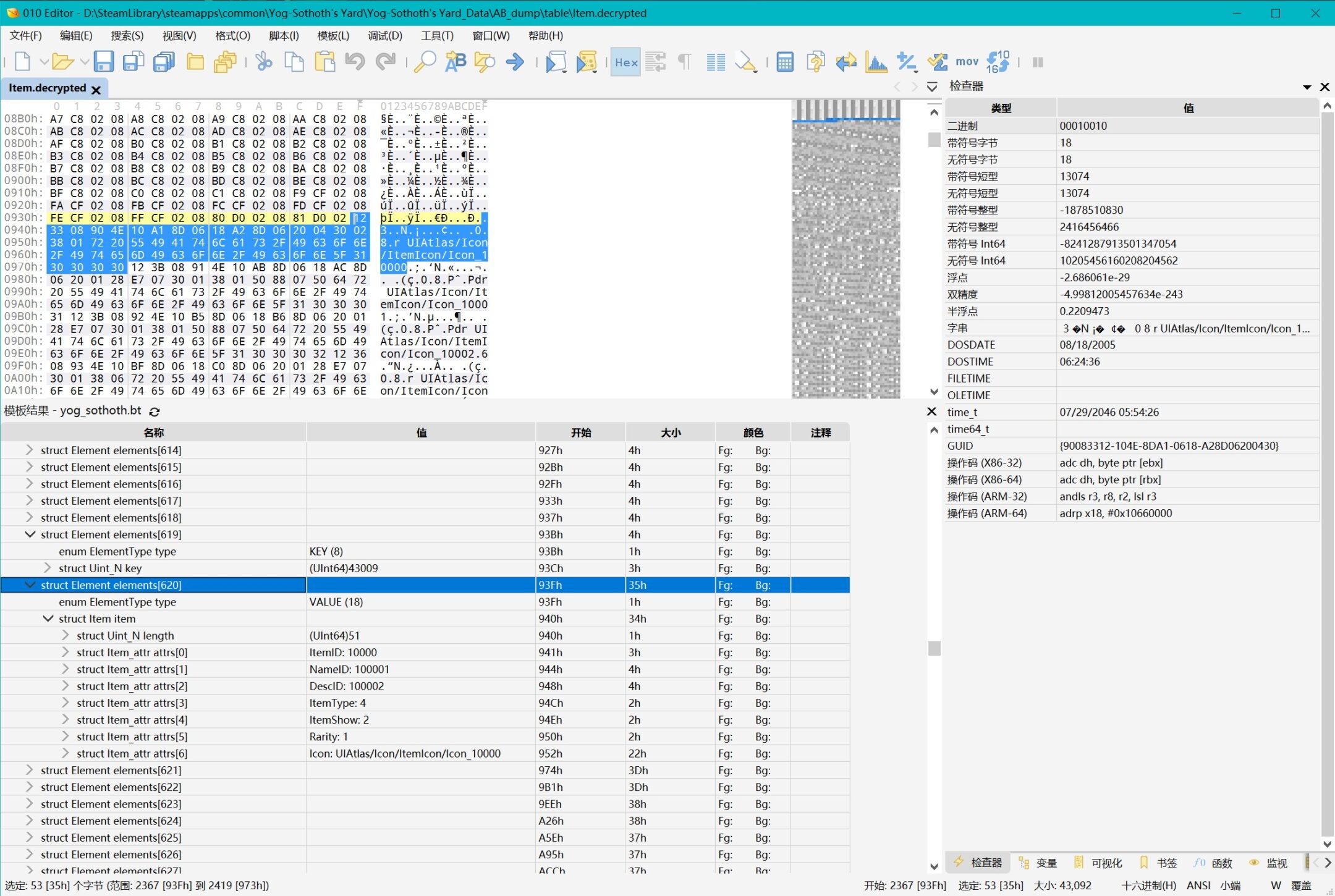
解析效果:
这里解析出的各种ID应该是需要去字符串数据库查的,所以说即使解析成功也无法得知物品与ID对应关系,除非从Icon看图标人脑辨认。而这个解析模板只能解析Item,这也是为什么说不建议复刻此类操作。
成功了,但是和没成功没什么区别。受不了了,一拳把地球打爆.jpg
后记
已经小半年没写博客了,这篇又是水货。很惭愧,但是拒不改正。不水的倒是有两篇,但是都在草稿箱睡了很久了,大抵是夭折了罢。
这次逆向说白了没什么目的性,真的需要做什么操作不如直接改C#轻松。
该去改点真正有用的东西了,比如说一次炼金一百个1之类的,然后继续闷头挣钱不管好感。
正好凑够四个章节,四个女主一人一张图,欸嘿~
你问桃子?那个算送的。






能解密fmod加密的bank文件吗?
从可行性上说,解肯定是可以解。但是我没有亲自实践,可以搜搜有没有其他用这个的游戏的解包。
FMOD Studio是个音频组件,一般来说应该不会在资源加密上下太多功夫?